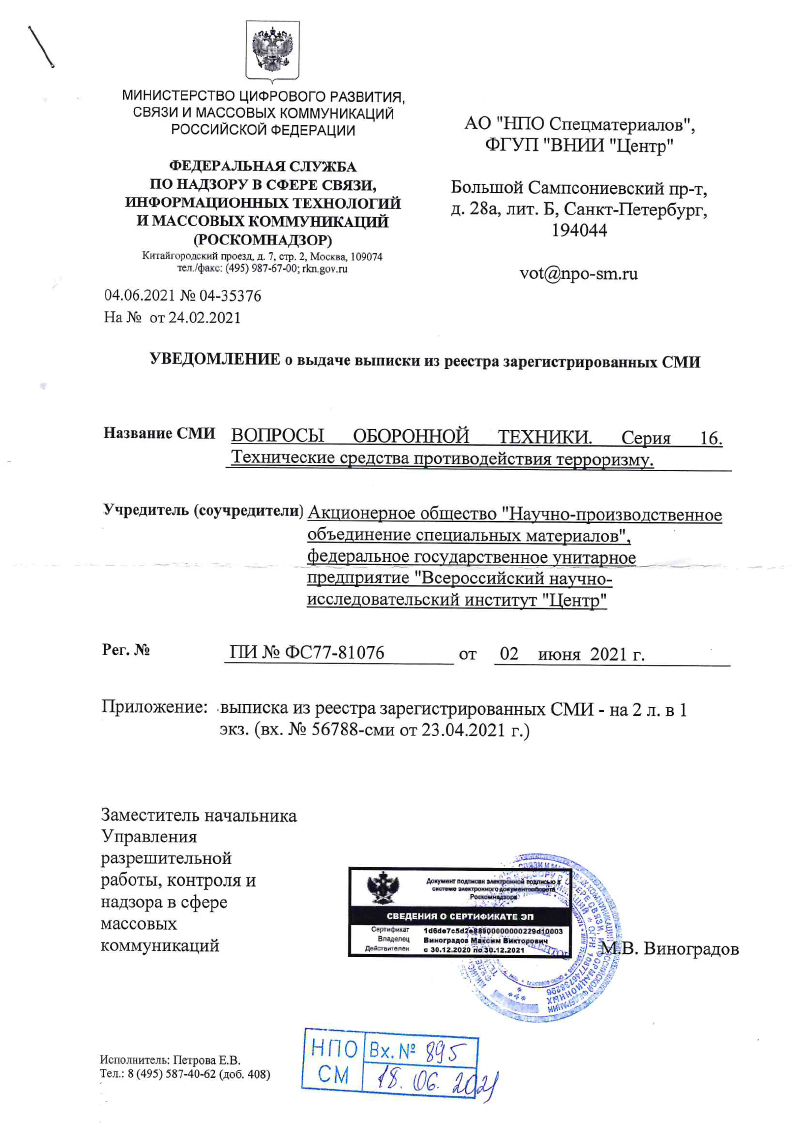
"Military Enginery Scientific and Technical Journal.
Counter-terrorism technical devices.Issue 16."
Issue (215-216)
Authors
Title
№
M.A. Savelyev
Title:
AUTOMATIC ADAPTIVE CONTROL OF A SET OF COGNITIVE SHORTWAVE RADIO EQUIPMENT
AuthorsM.A. Shelkovnikov M.A. Savelyev Key words:software and hardware complex, automatic adaptive control, complex of technical means, cognitive shortwave radio, cognitive radio systems, adaptive communication, intelligent agent | Annotation:The development of modern shortwave radio communication systems is largely focused on the use of cognitive radio technologies. Providing the functionality of systems built on the basis of these technologies involves the use of hardware complexes with automatic adaptive control. The practical implementation of such management is based on the use of a hardware and software complex based on an agent-based approach to the development of artificial intelligence systems. This approach makes it possible to ensure the use of effective adaptive communication methods in shortwave radio communication complexes based on taking into account the totality of a priori information about the propagation environment of radio waves, the signal-interference environment, the technical parameters of the radio equipment used and the rules for communication. Pages Code UDC: |
K.E. Legkov
D.O. Zaitsev
Title:
MATHEMATICAL MODEL FOR DETERMINING THE OBSERVED ANGLE OF A SPACE OBJECT BY GROUND-BASED INFORMATION AND MEASURING DEVICE
AuthorsV.V. Fedonin K.E. Legkov D.O. Zaitsev Key words:space object, kinematic and dynamic parameters of orbital motion, perturbed motion of space objects, non-coordinate information | Annotation:The article considers a mathematical model for determining the observed angle of space objects, taking into account the kinematic and dynamic parameters of orbital motion for specified boundary conditions. The results of simulation modeling of monitoring of a typical artificial Earth satellite (NORAD ID44323) through the range of an information measuring device are presented. The developed model makes it possible to form a multidimensional array of coordinate and time-angle measurements in the big data format necessary for preparing a representative training sample of neural network algorithms for classifying space objects. Pages Code UDC: |
V.V. Pakholia
I.S. Petrov
Title:
THREAT MODELING AND ATTACK SURFACE ANALYSIS OF A MICROSERVICE APPLICATION WITH CONTAINER VIRTUALIZATION IN AN ISOLATED COMPUTING ENVIRONMENT
AuthorsV.A. Lokhvitskii V.V. Pakholia I.S. Petrov Key words:microservice architecture, container virtualization, threat modeling, attack surface, information security | Annotation:The article examines information security issues for microservice-based applications operating within isolated computing environments using container virtualization. Based on the secure software development lifecycle methodology, comprehensive threat modeling is performed, beginning with the identification of critical system impacts. Particular attention is given to the decomposition of the attack surface specific to containerized environments, including inter-service interaction interfaces, container orchestration mechanisms, and image supply chain integrity. A structured description of potential vulnerability zones and an impact hierarchy is presented, providing a foundation for developing effective protection measures in air-gapped systems. The article is intended for information security specialists and developers of secure-by-design software. Pages Code UDC: |
S.G. Kozev
A.S. Vorobiov
R.V. Katiuha
Title:
THE METHOD OF ACCELERATED CALCULATION OF AIRCRAFT REACHABILITY AREAS BASED ON THE METHOD OF FACTOR ANALYSIS
AuthorsV.V. Pyatkov S.G. Kozev A.S. Vorobiov R.V. Katiuha Key words:aircraft, reachability area, factor analysis, regression function, optimal control, approximation | Annotation:For a maneuverable aircraft (LA), the application of the method proposed by O.A. Tolpegin for approximating its reachable area at a given moment of time by a triangular shape, both in the vertical and horizontal planes of its flight, is considered. The relationship between the coordinates of the vertices of the triangular reachable area (TRA) of the aircraft and such given initial data as the moment of time of approximation of the aircraft’s motion, the magnitude of its velocity module, the initial angle of inclination of the trajectory (or course for the horizontal plane), and others is shown. Algebraic expressions for regression functions are proposed, according to which the coordinates of the vertices of the triangular reachable area of the aircraft are calculated. It is proposed to use regression functions to accelerate the calculation of the coordinates of the vertices of the triangular reachable area of the aircraft, the coefficients of which are calculated based on the factor analysis method. Pages Code UDC: |
A.S. Goryansky
D.V. Volkov
Title:
METHODOLOGY FOR ANALYZING THE SIGNATURE OF REFLECTED RADAR SIGNALS FROM SPACE OBJECTS IN ORDER TO ASSESS THEIR INTEGRITY
AuthorsV.Ya. Prorok A.S. Goryansky D.V. Volkov Key words:effective scattering area, radar information, signature, space object, classification, near-Earth space, recognition | Annotation:The paper considers approaches to improving methods for data acquisition and analysis in the interests of a space situational awareness system for hazardous event prevention (ASPOS) in near-Earth space, focusing on the integrity of space objects. Particular attention is given to the processing and standardization of time-domain radar cross-section (RCS) signatures of space objects, as well as to the evaluation of an integral similarity metric for radio signal time series. Based on this metric, an approach is proposed to optimize decision-making regarding the integrity violation of a space object and to identify regions of increased monitoring priority, thereby enhancing the overall effectiveness of the ASPOS system. Pages Code UDC: |
Title:
A MODEL FOR EVALUATING THE CAPABILITIES OF A SPECIAL-PURPOSE STATIONARY COMMUNICATIONS HUB AS A MULTI-CRITERIA QUEUING SYSTEM
AuthorsO.V. Frolovsky Key words:queuing system, system status, availability coefficient, communication network, functional model, system status graph | Annotation:Fixed communication nodes operate under the conditions of mutual influence of two key factors — structural reliability and performance. The article offers an indicator of the efficiency of such a node: the availability coefficient, which, unlike classical metrics, takes into account not only parametric (failure rate, recovery time), but also structural properties (redundancy, topology of connections). The final model is obtained by complex integration of two submodels: the first describes the behavior of the system with limitations in terms of reliability, the second with performance limitations. This approach allows for a more adequate reflection of transitional and steady-state operating modes. The proposed availability coefficient makes it possible to quantify how structural redundancy compensates for reduced productivity and vice versa. Pages Code UDC: |
P.Yu. Bugaichenko
K.E. Zavgorodniy
Title:
AN APPROACH TO CONSTRUCTING A CONTROL SYSTEM FOR A HETEROGENEOUS GROUP OF ROBOTS USING A CONTROL DIGITAL TWIN
AuthorsA.E. Privalov P.Yu. Bugaichenko K.E. Zavgorodniy Key words:group control, robot, control digital twin, emergency situation | Annotation:This article explores the development of a robot swarm control system based on the use of a control digital twin. The paper clarifies several definitions and the concept of a control digital twin, proposes a model for a control digital twin of a robot swarm, and further refines it for building a control system for a swarm of unmanned aerial vehicles and ground robots performing the common task of searching for and extinguishing fires. The use of the presented control digital twin model enables the utilization of all the advantages of multi-agent systems and decentralized control without requiring the need to organize interactions within a heterogeneous robot swarm. Implementing the approach discussed in this article simplifies the robot control system itself, limiting its tasks to autonomous control of its own actions. Pages Code UDC: |
Title:
METHODOLOGY FOR OPTIMIZING THE FREQUENCY-HOPPING SPREAD SPECTRUM ALGORITHM FOR A RADIO COMMUNICATION NETWORK
AuthorsV.R. Bikbulatov Key words:frequency-hopping spread spectrum, optimization, iterative procedure, convex hull, anisotropic environment, frequency-time plan | Annotation:The paper presents a methodology for optimizing the frequency-hopping spread spectrum (FHSS) algorithm for a radio communication network operating in an anisotropic propagation environment under intentional interference. The methodology comprises six stages: frequency band state analysis, receiver decision rule optimization based on introducing an indifference region, potentially optimal plan formation using an iterative mixed strategy optimization procedure, transition moment determination, unconditional group plan formation, and FHSS key generation. Numerical simulation results demonstrate a gain of up to 6,2 dB compared to uniform frequency distribution. Pages Code UDC: |
A.V. Masalimov
Title:
THE ISSUE OF SYNTHESIS FOR IMITATION MODELS OF WEAPON, MILITARY AND SPECIAL EQUIPMENT
AuthorsYa.N. Gusenitsa A.V. Masalimov Key words:parametric synthesis, imitation, construction optimization | Annotation:The article discusses the issue of finding the optimal design for simulators of weapons, military and special equipment in the visible range. The solution is considered as an optimization problem, taking into account the constraints imposed on the objective function by objective factors. During the analysis of constraints, linear dependencies describing constraints were formalized, their analysis was carried out, and results were obtained that make it possible to determine the optimal design of a simulator of a sample of weapons, military and special equipment. Pages Code UDC: |
S.A. Garelina
A.Yu. Skrynnikov
Title:
METHOD FOR DYNAMIC DISTRIBUTION OF EMERGENCY RESPONSE FORCES BETWEEN OBJECTS OF EMERGENCY RESCUE AND URGENT WORKS
AuthorsG.A. Sharipov S.A. Garelina A.Yu. Skrynnikov Key words:emergency rescue operations, safe access, localization of accidents, elimination of emergencies, optimization of service interaction, rational distribution of forces, reservation of functions, combination of operations, efficiency of response | Annotation:The paper presents a methodology for dynamically distributing emergency response forces among damaged facilities. The methodology combines vector-based prioritization of facilities, which takes into account the differences in the functional tasks of fire and rescue units, emergency response teams, engineering, technical, and utility services, with a dynamic model of work completion time. A system of factors is proposed to generate independent priority vectors, an organizational prioritization coefficient is introduced, and a nonlinear production function with diminishing returns is used. A criterion for the appropriateness of force distribution is developed based on reducing the total work time. The methodology provides a reasonable approach to managing emergency response forces in a changing environment. Pages Code UDC: |
S.A. Yakovitsky
S.A. Vavrinuk
Title:
INTEROPERABILITY PROFILE OF AUTOMATED MILITARY SYSTEMS
AuthorsA.A. Ivanov S.A. Yakovitsky S.A. Vavrinuk Key words:interoperability, STANAG, standard, military-purpose system, automated system, NATO, interoperability profile, interagency cooperation | Annotation:The article discusses the need to develop an interoperability profile for automated military systems. It provides an example of implementing an interoperability profile in NATO countries. The article also formulates proposals for the content of an interoperability profile for automated military systems, taking into account interagency information exchange. The task of ensuring the functional compatibility of various automated military systems in the Russian Armed Forces and other law enforcement agencies is currently more urgent than ever, as evidenced by the experience of the Special Military Operation. To address this challenge, it is necessary to develop an interoperability profile for automated military systems. Pages Code UDC: |
D.A. Usov
Title:
THE MOBILE APPLICATION WITH SHOOTING TABLES FOR USE IN THE FIELD
AuthorsN.D. Bolotnikov D.A. Usov Key words:mobile application, firing tables, ballistic data, Android, step-by-step search algorithm, field conditions, artillery | Annotation:The article considers the development of a mobile application on the Android platform that provides quick access to firing tables for artillery systems without an automated fire control system. The hierarchical structure of ballistic tables was analyzed, and a step-by-step data search algorithm was developed that allows obtaining the required table in six sequential steps. A relational database and a multi-module application architecture were designed. The interface adapted to field operation conditions was implemented. A comparative experiment involving five testers was conducted to compare the effectiveness of searching for ballistic data in a mobile application versus using traditional printed firing tables. Pages Code UDC: |
A.I. Spivak
R.A. Pechenik
A.A. Kotova
V.D. Nasonov
Title:
SOME METHODOLOGICAL PRINCIPLES OF PROCESSING AND EVALUATION OF TEST RESULTS OF PROTECTIVE STRUCTURES OF INDIVIDUAL ARMOR PROTECTION MEANS FOR RESISTANCE TO THE IMPACT OF ARROW-SHAPED DAMAGE ELEMENTS
AuthorsA.S. Puchkov A.I. Spivak R.A. Pechenik A.A. Kotova V.D. Nasonov Key words:protective structure, personal armor, arrow-shaped projectile, firing test results, ultra-high-molecular-weight polyethylene, aramid fabric | Annotation:The article presents the most essential information that forms the methodological basis for processing and evaluating the results obtained during testing of protective structures of personal body armor to the impact of arrow-shaped damaging elements. The means and equipment used in the tests are also listed, along with explanations detailing the technical specifications, purpose, and specific features of use for developing the estimated resistance indicators for the protective structures. Experimental development of the test methodology was conducted at the laboratory facilities of the Testing Center for Special Materials and Products and the laboratory of the Research Institute of Special Materials, using protective structures made of aramid fabrics and ultra-high molecular weight polyethylene. Pages Code UDC: |
Title:
A METHOD FOR DIAGNOSING TECHNICALLY COMPLEX VEHICLE COMPONENTS
AuthorsA.A. Gorbachev Key words:identification of defects, depth of random vibration modulation, spectral analysis, frequency and amplitude of harmonic components, and construction of several reference systems with partially overlapping boundaries | Annotation:The article describes the diagnostic features and causes of defects in technically complex vehicle components, presents a developed diagnostic method that uses the occurrence of vibration modulation as a diagnostic feature of a detected defect, and establishes that the occurrence of defects in vehicle components is accompanied by the action of periodic oscillatory forces, including periodic shock pulses and periodically changing friction forces that generate random vibrations with periodically changing power. The diagnostic method developed and described in this article provides comprehensive diagnostic information during their capture and automatic processing using application programs used by electronic computing machines. Pages Code UDC: |
A.S. Puchkov
A.I. Spivak
S.N. Vasilieva
Title:
STUDY OF THE SPECIFIC PROPERTIES OF FOREIGN-MADE CAMOUFLAGE FABRICS AND THE SPECTRAL CHARACTERISTICS OF THE DYES IN THE NEAR-INFRACTORY RANGE
AuthorsN.M. Silnikov A.S. Puchkov A.I. Spivak S.N. Vasilieva Key words:camouflage fabric, dye, infrared range of the spectrum, spectral reflection coefficient | Annotation:This article presents the results of a study examining the properties of foreign-made camouflage fabrics and the spectral reflectance characteristics of dyes in the near-infrared range. Using a developed and patented method, the specific properties of camouflage fabrics were assessed under standardized laboratory conditions against a typical background «of deciduous undergrowth with shrubs» using a night vision device with a Class 3+ Ultra image intensifier tube. Using the Spectroton device, spectral reflectance characteristics of dyes used in fabric production were obtained. Statistical models of changes in the spectral characteristics of dyes depending on wavelength were developed. Pages Code UDC: |
D.I. Chistekhin
A.V. Kitaev
Title:
NUMERICAL SIMULATION DESTRUCTION OF MULTILAYER CERAMIC COMPOSITE ARMOR PLATES IN CASE OF BALLISTIC IMPACT OF A 9 MM BULLET
AuthorsD.V. Baklanov D.I. Chistekhin A.V. Kitaev Key words:yield stresses, FEM finite element method, local boundary integration of a Blockmap 3D-mesh, material breakage during fracture | Annotation:In this article, the deformations and destruction of the material of a multilayer ceramic composite armor plate during a ballistic impact of a 9-mm bullet on it are studied. The relevance of the research is the method of constructing a geometric model of ceramic composite armor and the physical properties of its material based on fundamental knowledge about deformation, taking into account thermal processes, as well as using numerical integration of partial differential equations, which are currently being implemented in validation with experimental studies using the method of reverse identification. The procedure for modeling the ballistic impact of a bullet into a ceramic composite armor plate using the FEM Finite Element Method is considered, which makes it possible to describe the separation of a material during its destruction by comparing experimental studies. Pages Code UDC: |
Title:
THE STEGANOGRAPHY APPLICATION DURING THE DATA LIFECYCLE
AuthorsM.F. Savelev Key words:steganography, life cycle stages, hidden data storage, hidden data processing, hidden data representation, hidden data placement, hidden data destruction | Annotation:The paper proposes a steganography existing areas systematization in accordance with the data lifecycle, and also identifies areas that were not previously classified as steganographic, but are actually steganographic. A review has also been conducted and a classification of steganographic methods used not only to protect information, but also taking into account known cases of data concealment during attacks on protected data and information resources. Consideration of approaches to data concealment in the interests of achieving different goals, together with taking into account the stages of the data lifecycle at which they (approaches) are implemented, expands the scientific and methodological apparatus of steganography. Pages Code UDC: |
A.E. Davladov
Title:
DEVELOPMENT OF A SECURE MOBILE PLATFORM FOR MANAGING PERSONAL MEDICAL DATA OF MILITARY PERSONNEL
AuthorsM.Yu. Ryzhova A.E. Davladov Key words:medical evacuation, military personnel, personal medical data, mobile platform, information security, Form 100, voice input, local data storage | Annotation:The article describes the developed mobile platform for managing personal medical data of military personnel, designed for use at the stages of medical evacuation in the absence of stable communication. The platform provides secure local storage of medical records, their sequential transfer between evacuation stages, voice and manual completion of Form 100, and generation of aggregated data on medication use. The implementation of the platform made it possible to ensure continuity of medical documentation, reduce repeated data entry, and improve the preservation of clinically significant information. Pages Code UDC: |
Title:
HYGIENIC ASPECTS OF MILITARY PERSONNEL TRAINING IN THE SAFETY REQUIREMENTS OF MILITARY SERVICE
Authors S.A. Tsutsiev Key words:military personnel, security, military service, education, training, hygiene | Annotation:The article is devoted to substantiating the need for all interested parties to study the hygienic aspects of the safety of military service. At the end of the 20th century, the Russian army and Navy developed and implemented the Military Service Safety management system, which was credited with success in protecting the life and health of military personnel. However, it soon became clear that the results achieved did not fully meet the expectations: the number of dead and injured soldiers still remains tall. One of the reasons for this dissonance lies in the imperfection of military personnel training, in particular, it concerns the mandatory study of hygienic safety issues, without knowledge of which it is difficult to achieve the desired result. Pages Code UDC: |