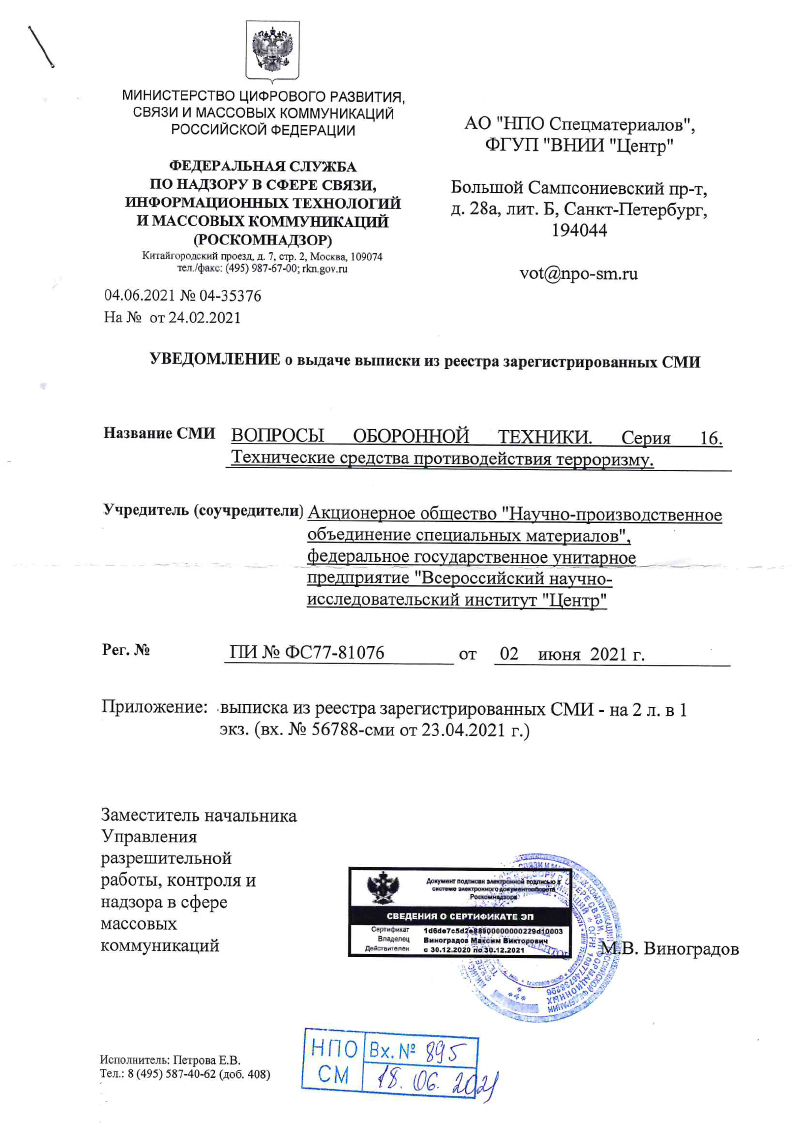
"Military Enginery Scientific and Technical Journal.
Counter-terrorism technical devices.Issue 16."
Issue (211-212)
Authors
Title
№
V.V. Kulakov
O.Yu. Kashirina
E.I. Kashirina
S.A. Fominykh
Title:
ESCALATION OF NATO COUNTRIES' ARMAMENTS IN THE AREA OF MODERN MILITARY OPERATIONS: SOURCES OF FINANCING FOR UNMANNED AIRCRAFT SYSTEMS
AuthorsV.V. Shamanov V.V. Kulakov O.Yu. Kashirina E.I. Kashirina S.A. Fominykh Key words:modern military operations, UAVs, defense spending, arms supplies, ammunition, exports, imports, drones, economy, costs | Annotation:The article presents the dynamics of the development and influence of unmanned aerial vehicles (UAVs) on modern military conflicts and the geopolitical situation in general. Special attention is paid to the changing structure of the UAV market. Using materials from foreign publications, the authors analyze the economic and political aspects of arms supplies using the example of military aid to Ukraine. The article argues that the development of UAVs not only reflects technological progress, but also serves as a tool for pursuing economic and political interests in a global competitive environment Pages Code UDC: |
G.V. Dudalev
M.A. Aleksandrov
A.O. Muminov
S.V. Mishcheryakov
Title:
PROSPECTS FOR THE USE OF SIMULATION MODELS AND DIGITAL TWINS OF MILITARY ORGANIZATIONAL AND TECHNICAL SYSTEMS
AuthorsE.P. Minakov G.V. Dudalev M.A. Aleksandrov A.O. Muminov S.V. Mishcheryakov Key words:military organizational and technical system, simulation model, digital twin, artificial intelligence, weapons and military equipment | Annotation:The article defines the goal of developing and creating a leading methodological and scientific-methodological reserve in the field of simulation modeling and the development of digital twins in the Armed Forces of the Russian Federation. Ways to achieve goals that comprehensively ensure high stability and efficiency of the use of military organizational and technical systems, timeliness, validity and intelligence of decision-making support when managing the Armed Forces of the Russian Federation. Problematic issues are considered, and it is shown that the main directions of development are the creation of specialized modeling tools, increasing the scenario complexity and adequacy of mathematical models, the use of artificial intelligence, the development of digital twins and control digital twins. Pages Code UDC: |
N.M. Silnikov
A.I. Spivak
N.N. Vasiliev
Title:
SOME ASPECTS OF ASSESSING THE POSSIBILITY OF USING EXPLOSION PROTECTION DEVICES BASED ON A GAS-LIQUID DISPERSANT TO PREVENT CONSEQUENCES OF AN EXPLOSION ON BOARD AN AIRCRAFT
AuthorsM.V. Silnikov N.M. Silnikov A.I. Spivak N.N. Vasiliev Key words:explosion on board an aircraft, explosion protection device, shock wave, shock wave front overpressure, field testing | Annotation:The article considers the possibility of using explosion protection devices based on a gasliquid dispersant to localize explosive devices on board an aircraft. Based on mathematical modeling, the possibility of reducing the level of excess pressure of the shock wave front during detonations of standard explosive charges to the level regulated by the Aviation Rules was established. The reliability of the mathematical modeling results was confirmed during field tests of prototypes of the «Fountain» aviation explosion protection devices based on a gas-liquid dispersant: a mobile version intended for use in narrow-body and wide-body aircraft, as well as a stationary version intended for use in wide-body aircraft. Pages Code UDC: |
O.A. Plakhin
A.O. Kormosh
M.P. Biryukov
Title:
METHOD FOR SELECTING THE MOST RELIABLE DIAGNOSTIC MODEL OF AN ACTIVE SPACE OBJECT BASED ON AN ASSESSMENT OF ITS VALIDITY
AuthorsV.V. Tkachenko O.A. Plakhin A.O. Kormosh M.P. Biryukov Key words:active space object, diagnostic model, validity, reliability, automated systemcognitive analysis, F-measure | Annotation:The article presents a methodology for selecting the most reliable diagnostic model of active space, based on an assessment of validity using automated system-cognitive analysis. The procedures for constructing competing system-cognitive models and their verification by calculating the F-measure, a complex indicator that evaluates the accuracy and completeness of the classification of objects in the training sample, are considered. An algorithm has been developed for selecting the most adequate model that maximizes the integral value of the F-measure while observing the specified thresholds of differential validity for critical classes of technical conditions. The method provides a quantitative assessment of the information significance of diagnostic features and allows you to work with heterogeneous and incomplete telemetry data. Pages Code UDC: |
A.Yu. Skrynnikov
G.A. Sharipov
Title:
THEORETICAL FOUNDATIONS OF RATIONAL DISTRIBUTION OF EMERGENCY RESPONSE FORCES IN A MULTIZONE STRUCTURE OF EMERGENCY RESCUE AND OTHER URGENT WORK OBJECT
AuthorsS.A. Garelina A.Yu. Skrynnikov G.A. Sharipov Key words:emergency rescue operations, safe access, localization of accidents, emergency response, optimization of service interaction, rational distribution of forces, redundancy of functions, combined operations, response efficiency | Annotation:The article presents the theoretical foundations of a zonal approach to the rational distribution of forces in emergency situations, taking into account the complexity of operations and the composition of acceptable performers. The article formulates fundamental principles for optimizing the interaction between services and minimizing organizational and technological delays. A system of formalized parameters and restrictions has been developed, including coefficients for combining actions and ensuring the continuity of the process, indicators of complexity, and criteria for safe tolerance. The practical application of the theoretical principles has been confirmed by an analysis of emergency situations, demonstrating the applicability of the zonal approach in real-world conditions. The developed methodology can be used in the development of regulations for emergency response services. Pages Code UDC: |
A.Yu. Skrynnikov
S.A. Garelina
Title:
ALGORITHM FOR RATIONAL DISTRIBUTION OF FORCES FOR ELIMINATING EMERGENCY SITUATIONS AT A SINGLE FACILITY FOR EMERGENCY RESCUE AND OTHER URGENT WORK
AuthorsG.A. Sharipov A.Yu. Skrynnikov S.A. Garelina Key words:emergency rescue operations, rational force distribution algorithm, emergency response, multi-zone safety model, zone parallelism | Annotation:The article presents an applied algorithm for the rational distribution of emergency response forces, based on a multi-zone safety model and formalized principles of service interaction. The algorithm includes zone identification, labor intensity assessment, determination of the time to achieve a safe state, and optimization of service admission sequence. The practical application of the algorithm is demonstrated using the example of a fire in a residential building. Allowing for quantitative assessment of the impact of zone parallelism and adjustment of admission moments on the time required to eliminate an emergency. It has been shown that the proposed algorithm can significantly reduce organizational and technological delays and minimize the total time of emergency and rescue operations. Pages Code UDC: |
D.S. Kurkov
I.A. Oleshko
Title:
SOLUTION OF THE NON-STATIONARY HEAT CONDUCTIVITY PROBLEM OF WOODEN CONTAINERS WITH FIRE-RESISTANT COATING FOR AMMUNITION IN FIRE CONDITIONS
AuthorsS.N. Kurkov D.S. Kurkov I.A. Oleshko Key words:packaging, fire-resistant coating, flame retardants, finite element method, thermal conductivity, fire resistance of containers | Annotation:The problem of non-stationary thermal conductivity of wooden containers for ammunition with a fire-resistant coating under the influence of fire has been solved. The purpose of the calculation was to determine the time required to heat the mine to 170 °С and the distribution of the temperature field over the box and the mine. The Fourier equation was used to describe heat transfer in a three-dimensional setting. The constructed 3D-model takes into account the flame temperature, the heat capacity of the ammunition, and the thermal conductivity of the container wood. The problem was solved using the finite element method. It has been established that containers with applied OZP protect mines from flame exposure for at least 20 minutes. The 3D-model allows solving the problem of heat transfer for containers made of other modern materials. Pages Code UDC: |
Title:
METHODOLOGY FOR ASSESSING THE DESIGN READINESS OF MILITARY PRODUCTS BASED ON A RISK-BASED APPROACH IN A LIFE CYCLE CONTRACT
AuthorsA.A. Melekhin Key words:project readiness, risks, life cycle contract | Annotation:This article presents a risk-based design readiness assessment methodology for a lifecycle contract. The methodology’s mathematical framework utilizes an exponential distribution law to calculate the design readiness factor. This indicator provides a readiness assessment based on the results of the design phase. To address this issue, the following methods were used: «Failure Mode, Effect, and Criticality Analysis,» «Fault Tree,» and «Event Tree.» These methods were implemented using the Windchill Quality Solutions package. Practical application of this methodology can provide additional opportunities for lifecycle contract parties to ensure the specified level of readiness during the operational phase when using a risk-based approach to military product development. Pages Code UDC: |
D.I. Chistekhin
Title:
PARALLEL DATA PROCESSING ALGORITHM IN SECOND-ORDER SNS
AuthorsV.O. Baiguzov D.I. Chistekhin Key words:parallel algorithm, second order, vector matrix architecture | Annotation:This article discusses a parallel algorithm for data processing in second-order convolutional neural networks, focused on vector-matrix processors, with the introduction of artificial intelligence technology into reconnaissance devices. The basic principles of implementing convolutional neural networks on processors with vector-matrix architecture are formulated, including: optimal use of shadow and working matrices, vector registers of the processor, optimal hardware implementation of activation functions, the use of weighted summation and masking operations. The basic principles of data processing in neurons with secondorder adders are revealed. Pages Code UDC: |
M.O. Gabtullina
I.B. Saenko
Title:
AN APPROACH TO THE APPLICATION OF MACHINE LEARNING METHODS FOR DETECTING ABNORMAL USER BEHAVIOR IN AUTOMATED MILITARY SYSTEMS
AuthorsA.V. Sazhina M.O. Gabtullina I.B. Saenko Key words:machine learning, cybersecurity, automated military systems (AMS), anomaly detection, insider threats, SQL injection | Annotation:In the context of digital transformation of infrastructure, the problem of ensuring the security of automated military systems is becoming increasingly important. This article focuses on solving the problem of detecting abnormal user behavior in automated military systems, which is a serious cyber threat, especially in the context of insider attacks. A comprehensive approach is proposed that combines semantic processing of database logs, the generation of synthetic anomalies, and the use of machine learning algorithms. A comparative study of the effectiveness of four anomaly detection algorithms is conducted. The developed methodology opens up new possibilities for creating automated military systems security systems. Pages Code UDC: |
I.A. Kubasov
Title:
ON THE CREATION OF A HIGH-SPEED ARMORED SMALL VESSEL FOR THE PERFORMANCE OF OPERATIONAL AND SERVICE TASKS BY UNITS OF THE RUSSIAN MINISTRY OF INTERNAL AFFAIRS
AuthorsV.I. Sushkov I.A. Kubasov Key words:small vessel, armor protection, armored boat, protective structure class, bullet resistance | Annotation:In today’s changing geopolitical climate, the threat of terrorist attacks using a variety of weapons, and given Russia’s vast waters, the development of a high-speed armored small vessel for the effective performance of operational tasks by units of the Russian Ministry of Internal Affairs is particularly urgent. This article substantiates the need for a combination of active and passive protection measures for small vessels, as well as the use of modern armor materials and methods. It is proposed to achieve an optimal balance between armor protection and the functionality of small vessels by using localized armor plating of the most vulnerable areas, components, and assemblies. Pages Code UDC: |
T.D. Shidlovskii
M.M. Tsygankov
A.K. Borisov
E.M. Ivankova
V.I. Siklitskii
Iu.M. Boiko
V.A. Marikhin
Iu.E. Karmazova
O.S. Novak
N.M. Silnikov
Title:
MONOLITIZATION OF REACTOR POWDERS OF ULTRA-HIGH-MOLECULAR-WEIGHT POLYETHYLENE SYNTHESIZED USING DIFFERENT CATALYTIC SYSTEMS
AuthorsL.P. Miasnikova T.D. Shidlovskii M.M. Tsygankov A.K. Borisov E.M. Ivankova V.I. Siklitskii Iu.M. Boiko V.A. Marikhin Iu.E. Karmazova O.S. Novak N.M. Silnikov Key words:ultra-high-molecular-weightpolyethylene, reactor powders, monolythization, sintering, compacting | Annotation:The work studied the monolithicization of ultra-high-molecular-weightpolyethylene powders synthesized using metallocene (Oz4838) and modified titanium-magnesium (M3659) catalysts. SEM, DSC, and thermoluminescence methods were used to investigate the effect of compaction and sintering conditions on the morphology, molecular mobility, and mechanical properties of precursors. It was found that the M3659 powder has better monolithicization ability, forming denser and stronger precursors with lower surface defectiveness. Increasing the sintering temperature to 135°C reduces strength, likely due to increased macromolecular chain scission. Temperature regimes that prevent the remelting of the polymer's initial structure were scientifically substantiated. The results are important for developing solvent-free methods of processing ultra-high-molecular-weightpolyethylene into high-strength materials. Pages Code UDC: |
T.D. Shidlovsky
Yu.M. Boyko
L.P. Myasnikova
G.V. Vaganov
E.M. Ivankova
O.S. Novak
N.M. Silnikov
Title:
PROSPECTS FOR OBTAINING HIGH-STRENGTH TEXTILE MATERIALS BASED ON THE MAIN TEXTILE WEAVES
AuthorsM.M. Tsygankov T.D. Shidlovsky Yu.M. Boyko L.P. Myasnikova G.V. Vaganov E.M. Ivankova O.S. Novak N.M. Silnikov Key words:high-strength knitwear, ultra-high-molecular-weightpolyethylene gel fibers, elastic weave, physical and mechanical properties, kink bands, scanning electron microscopy, composite materials | Annotation:The study explores the prospects for producing high-strength textile materials based on ultra- high-molecular-weightpolyethylene gel-spun fibers obtained via gel technology using different solvents (decahydronaphthalene and mineral oil). The aim was to develop «1+1 rib» knitted fabrics from high-strength yarns Ch-88 and GL-28 and evaluate their physicomechanical properties. A comparative analysis of yarn knitability, strength, and elongation of the fabrics was conducted on an Instron tester. Scanning electron microscopy revealed large-scale defects (drop-stitch bands) that negatively affect material strength. The fabric from the thicker Ch-88 yarn is 40 % stronger but has 2 times lower elongation compared to the GL-28 yarn fabric. Pretreatment of yarns with an emulsion based on knitting waxes is proposed to reduce defect formation. Pages Code UDC: |
V.V. Martynov
Title:
MODERNIZATION OF THE PNEUMATIC LAUNCHING SYSTEM
AuthorsM.V. Zhitnyy V.V. Martynov Key words:pneumatic launching system, high-speed impact studies, impactor launching, light-gas gun, ballistic complex | Annotation:An analysis of the operation of the BS-3 ballistic complex revealed the need to improve its technical capabilities in terms of expanding the range of particle velocities used for testing the elements of spacecraft. The proposed solution to this problem involves integrating a pneumatic launching system into the complex. To successfully adapt the system, a series of modernization measures have been developed, most of which have been implemented on an experimental and laboratory basis. The results of the tests have confirmed the correctness of the selected directions for the modernization of the pneumatic launching system, as well as the idea of its integration into the BS-3 ballistic complex. Pages Code UDC: |
D.Y. Golubev
Title:
A FORMALIZED DESCRIPTION OF THE PROCESS OF REDUCING THE VOLUME AND A SPECIALIZED TECHNICAL TOOL FOR THE DISPOSAL OF NON-RECOVERABLE MILITARY EQUIPMENT IN THE FIELD
AuthorsV.V. Nechaev D.Y. Golubev Key words:logarithmic degree of deformation, deformation resistance, generalized Hooke’s law, coefficient of friction on the plate, volume of non-recoverable military equipment, specialized collapsible-mobile device | Annotation:The requirements for the disposal of a certain military equipment object should be included in the development of the technical specifications for its creation. The main requirement for ensuring environmental safety and adaptability of military equipment for disposal, which would guarantee a solution to the problem of reducing economic costs and labor intensity, should be to ensure a high level of resource conservation. Military equipment can be disposed of in a way that maximizes the use of the resulting products for the production of secondary materials, provided that the recycling processes are organized in a specific technological sequence and that this sequence is determined by the design parameters of the military equipment and the technical logic of the disposal process in all its phases. Pages Code UDC: |
M.S. Veryovkin
T.A. Grigoriev
Title:
EXPERIMENTAL EVALUATION OF INTERNAL STRESSES OF SPRAYED MULTILAYER POLYMER COATINGS OF SPECIAL-PURPOSE EQUIPMENT
AuthorsA.Yu. Andryushkin M.S. Veryovkin T.A. Grigoriev Key words:multilayer polymer coating, internal stresses, residual stresses, coating structure, cantilever method, deflection arrow | Annotation:The service life of a polymer coating is determined by the magnitude of its internal stresses. The appearance and development of defects are caused by significant internal stresses arising from significant shrinkage of the sprayed polymer composite. An experimental study was conducted to determine the internal stresses in a multilayer polymer coating on a steel substrate using a cantilever bending method. It was found that increasing the number of individual layers with the same polymer coating thickness reduces internal stresses. An empirical relationship was obtained between the internal stresses in the polymer coating of a sample and the number of individual layers. Increasing the number of individual polymer coating layers beyond eight is impractical, as it does not reduce internal stresses. Pages Code UDC: |
Yu.E. Karmazova
O.S. Novak
R.N. Zaitsev
Title:
ULTRA-HIGH-MOLECULAR POLYETHYLENE: PROPERTIES, SYNTHESIS AND APPLICATIONS
AuthorsA.A. Platunova Yu.E. Karmazova O.S. Novak R.N. Zaitsev Key words:ultra-high-molecular-weight polyethylene (UHMWPE), catalysts for the synthesis of UHMWPE, forms of UHMWPE, methods of UHMWPE processing | Annotation:This article provides a detailed overview of ultra-high-molecular-weight polyethylene (UHMWPE) — a high-tech thermoplastic that holds a special place among modern structural materials due to its unique combination of outstanding operational properties. The key characteristics that define its uniqueness are analyzed in detail: exceptional impact strength, highest wear resistance, chemical inertness, and low coefficient of friction. The history of the material's creation, specific processing methods, as well as a wide range of current applications — from personal armor protection and medical implants to wear-resistant components of industrial equipment — are examined.. Pages Code UDC: |
A.V. Tolov
I.I. Rudenko
V.V. Tolov
Title:
EVALUATION OF PROTECTIVE ABILITY OF SOME RIFLE OILS (IN REAL CONDITIONS)
AuthorsChirkov A.V. Tolov I.I. Rudenko V.V. Tolov Key words:gun oils, preserrvative oils, corrosion protection, corrosion, corrosive foci, protective ability, test, real conditions, maintenance of small arms, military equipment | Annotation:This paper presents the results and analysis of the protective properties of gun oils. Comparative tests of eight samples of domestic gun oils were conducted: neutral gun oil «Berkut», gun oil «LIKSIR», industrial oil «I-20A», neutral gun oil «Axiom», neutral gun oil «Taiga», neutral gun oil «Nuclear protection», gun lubricant spray «AG autogur » PREMIUM, gun oil RZh «KUDO». The tested gun oils were shown to have similar protective properties, but samples No 4, No 5, and No 6 were superior to similar gun oils in their ability to protect grade 10 steel under real-world conditions. Pages Code UDC: |
A.A. Ivanov
S.A. Vavrinyuk
Title:
U.S. ARMY COUNTERINTELLIGENCE SYSTEM
AuthorsS.A. Yakovitsky A.A. Ivanov S.A. Vavrinyuk Key words:agents, Armed Forces, foreign intelligence, counterintelligence, national security, crimes, processing intelligence evidence, investigations, force protection, Army, terrorist, threats, vulnerability, espionage | Annotation:In the current conditions of intensification of all types of intelligence, increasing the role of special operations forces, active use by foreign states of «soft», «hybrid» means and methods of influencing a potential enemy, the importance of counterintelligence forces is greatly increasing. In the United States, in all types of armed forces, a military counterintelligence system is deployed and fully functioning. The article discusses the guidelines, the structure of the counterintelligence system deployed in the ground forces, the technical equipment of units (communication and automation equipment), the requirements and features of training specialists, their duties and powers. Pages Code UDC: |
Title:
«SPECIAL CONDITIONS» OF MILITARY SEAMEN’S SERVICE
AuthorsS.A. Tsutsiev Key words:hygienic assessment, conditions of naval service, military seamen, military personnel, Navy, Armed Forces of the Russian Federation, special conditions of military service, hygienic classification, social guarantees, criteria of conformity, hazards, occupational risks, harmful and (or) dangerous factors | Annotation:The article is devoted to the analysis of the current classification of conditions of military service in the Russian Navy. It has been established that the assessment of the conditions of service of military seamen is based on the concept of «special conditions», which is controversial because it does not have a proper scientific basis: in particular, accurate and reliable criteria for compliance have not been developed, there are no objective methods for identifying them, etc. This allows us to consider the concept of «special conditions» as an approximate collective indicator with a very wide range of conditions of military work. As a result, a precedent is being set for unjustified refusal to assign social guarantees to military sailors in relation to specific jobs. At the same time, the military leadership bodies in the Navy, due to the lack of appropriate resources, are unable to promptly manage the process of saving the lives of personnel in the format of the «Security of military service» system. Pages Code UDC: |